Controlling how peptide-chromophore conjugates pack at the molecular level is a central challenge in supramolecular materials design. Even small structural changes can redirect assembly toward kinetically trapped or thermodynamically stable states with sharply different chiroptical, morphological and excited-state properties. Pyrene is an especially sensitive reporter in this context: its excimer behavior, fluorescence lifetime, and chiroptical response all shift measurably with intermolecular packing geometry. Understanding the structural parameters that govern these outcomes is therefore essential for building adaptive soft materials with programmable photophysical behavior.
Researchers in the Ghosh Group at the Centre for Nano and Soft Matter Sciences in Bengaluru, India, published in Polymer Chemistry, synthesized two pyrene-conjugated tetrapeptides, PEP-0 and PEP-1, that differ only in the length of the spacer connecting the pyrene chromophore to a phenylalanine-lysine-phenylalanine-aspartic acid backbone. Both compounds were prepared using standard Fmoc-based SPPS, then characterized by a combination of UV-Vis, photoluminescence, FTIR, circular dichroism, and NMR spectroscopies, supported by field-emission scanning electron microscopy, atomic force microscopy, dynamic light scattering, density functional theory calculations at the B3LYP/6-31G level, and 200 ns molecular dynamics simulations.
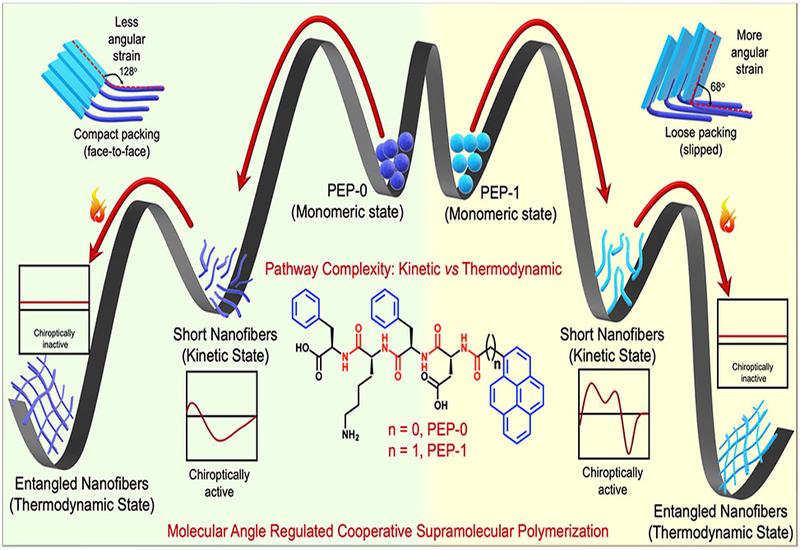
Density functional theory geometry optimizations revealed that the spacer difference produces a 60° divergence in the angle between the chromophore and the peptide segment: PEP-0 adopts approximately 128° and PEP-1 approximately 68°. This geometrical change translates directly into distinct packing modes. In aqueous medium, PEP-0 shows a hypsochromic UV-Vis shift of roughly 5 nm consistent with face-to-face π–π stacking, while PEP-1 displays a bathochromic shift to 353 nm indicative of slipped π-stacking. Circular dichroism spectra confirm that the two assemblies carry different excitonic coupling signatures and different chiroptical outputs. Despite these packing differences, both peptides form short one-dimensional nanofibers, showing that directional hydrogen bonding drives the macroscopic morphology while the pyrene geometry controls the internal organization.
Molecular dynamics simulations over 200 ns corroborate the spectroscopic studies. PEP-0 forms compact, structurally stable aggregates with sharper and more intense radial distribution function peaks at short pyrene-pyrene distances, consistent with tighter face-to-face contacts. PEP-1 assembles into looser, dynamically reorganizing aggregates with broader radial distribution functions. The greater conformational flexibility introduced by the methylene spacer in PEP-1 also suppresses non-radiative deactivation, yielding fluorescence lifetimes of roughly 139 ns compared to roughly 12 ns for PEP-0. Temperature-dependent studies then establish pathway complexity in both systems. Heating to 363 K disassembles both peptides to monomers; cooling back to 298 K recovers aggregation confirmed by UV-Vis but produces chiroptically silent assemblies in both cases. Thermal annealing bypasses the kinetically trapped chiral state and delivers a thermodynamically stable, chiroptically inactive state. Morphologically, the thermodynamic state features long entangled nanofibers, in contrast to the short fibers of the kinetic state. Nucleation-elongation modeling of the heating and cooling curves yields a thermal hysteresis of 28 K for PEP-0 and 31 K for PEP-1, confirming kinetic control, and cooperativity factors on the order of 10−3 to 10−4 for both systems.
This work establishes spacer-directed molecular angle engineering as a practical lever for controlling supramolecular polymerization pathways, chiroptical properties, and excited-state dynamics in peptide-chromophore systems. The ability to select a chiroptically active kinetically controlled state or chiroptically inactive thermodynamically stable state through thermal annealing, combined with tunable fluorescence lifetimes spanning more than an order of magnitude, points toward next-generation functional soft materials for applications in optoelectronics, sensing, bioimaging, photonic materials, and advanced supramolecular nanotechnologies. The mechanistic framework developed here provides clear design principles for the broader class of peptide-based soft materials.